Medford
Tisch Library
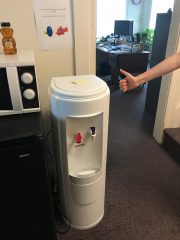
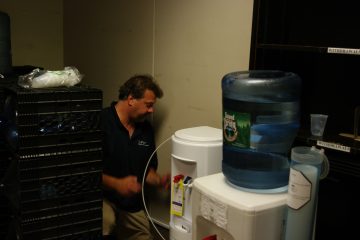
The Tisch Sustainability Team (TST) first started when Eco-Ambassador Laurie Sabol joined forces with fellow Eco-Ambassador Jess Warner to work on recycling, composting, energy savings, and filtered water in their office. To help meet TST’s goal of having one member per year become an Eco-Ambassador program, Kris Thompson participated in the program in 2010. They successfully installed a water filter to replace their spring-water bubblers with eco-friendly tap and maintained two office kitchen compost bins.
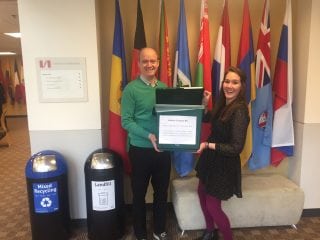
During FY13, TST, made up of members Kate Bronstad, Amey Callahan, Carol Ellis, and Jessica Warner, organized a number of sustainability events and initiatives. They worked with Dan Hurwit at Ginn Library to create a Freshmen Orientation Open House film “A Tale of Tisch” based on Annie Leonard’s “Story of Stuff,” held their second Green Book initiative to add sustainable books and films to the library’s collection with grant money, and organized an Earth Day Celebration that worked in conjunction with the Green Book initiative and featured an interactive poster for Tisch users.
In addition, they expanded TerraCycle collection to the Tower Café, promoted decision-making for space renovation by recommending ideas to the library Director and Space Team, met with Betsy Isenstein in Facilities regarding the building’s energy use, and held a series of Green Events that encouraged employees to BYOP (Bring Your Own Place-setting). Tisch Library also received the “Gold” level Green Office Award and was awarded a $200 Eco-Ambassador Grant.
In June 2013, TST organized a Sustainable Transportation Event to educate employees about ways to reduce commuting costs, support alternatives to single-occupancy cars, and make commuting easier.
Department of Music, Granoff Music Center
Elizabeth Erenberg, Coordinator of Music Events in the Department of Music at the Granoff Music Center, has implemented a highly successful battery recycling program, instituted office composting, ensured that recycling bins are distributed equally throughout the building, and coordinated with Facilities to start using recycled paper towels in restrooms. She also posted signs encouraging people to use stairs instead of the elevator, greatly increasing foot traffic on the stairs and yielding energy savings, as well as signs encouraging colleagues to use reusable coffee mugs, thus reducing the use of disposable paper cups. In addition, Elizabeth started a “Green Team,” which has identified further initiatives such as more eco-friendly coffee machines.
Tufts Boston School of Occupational Therapy
Since completing the Eco-Ambassador program in 2009-2010, Fay Martin, the Staff Assistant in the Occupational Therapy Department, began a monthly eco-newsletter. She also facilitated the conversion of a basement room at 26 Winthrop St into a place, now called Free Cycle, where members of the Tufts community can drop out any unwanted items or “shop” around and take what they want. The center also serves as a space for students to set up charity collections stations, such as Soles 4 Souls and the Giving Tree. Members of the community can share their green activities on the bulletin boards at Free Cycle as well.
Department of Education
Lori Jackson, Staff Assistant in the Education Department, gave a presentation in her staff meeting about the things she learned during the Eco-Ambassador program and was joined afterward by a group of colleagues who were interested in pursuing other ways to save money and resources in the department. Their first office venture in sustainability was switching to reusable dishes.
After participating in the 2009-2010 Eco-Ambassador program, Carla Walsh received a grant which, along with the money her department saved by switching to filtered water, allowed her to purchase an energy-efficient refrigerator and freezer unit for the office. Since then, the office instated new recycling measures, significantly increasing recycling compliance amongst the faculty. Currently, they are interested in setting up a compost system in their office space.
Eco-Ambassador Ryan Redmond, Lecturer in the Education Department, works with Lori and Carla to change the culture in the office to be more environmentally friendly.
Feinstein International Center
Administrative Assistant Anita Robbins at the Feinstein International Center used her experience as an Eco-Ambassador to push for increased action in her already highly environmentally conscious office. Some of the changes the office made were installing light sensors and programmable thermostats, setting office printers to print double sided by default, implementing phone and video conference calls to reduce their carbon footprint, and eradicating bottled water from the office. More examples of the office’s green initiatives can be found here.
The Fletcher School
Mieke van der Wansem, Associate Direction of CIERP, worked with former staff member Kate Chroust to bring environmental change to the Fletcher School. The Office of Sustainability was invited to present about recycling at the first staff meeting in 2009 to a very enthusiastic audience. Since then, they have been working with students and Dawn Quirk, Waste Reduction Manager, to facilitate recycling in Fletcher, help with a waste sort, install new recycling bins, and add signs.
200 Boston Ave.
Michael Doire, the Research Coordinator at the Advanced Technologies Laboratory located at 200 Boston Ave., has been working to create a more sustainable research environment. His initiatives have included improving recycling at the lab, replacing bottled water with tap, and installing bike racks on the premises.
80 George St.
After completing the Eco-Ambassador program, former Advancement staff member Amanda Yost Parker hosted MassRides in the lobby of 80 George Street during Spring 2009, bringing information and materials about alternatives to single-occupancy commuting to that oft-parking-stressed location.
Joanie Tobin, who worked in University Relations and Publications but has since left Tufts, was a 2008 Eco-Ambassador graduate who took great pride in educating her fellow colleagues. Not only did she give a presentation at her staff meeting, she also started an office waste reduction campaign.
Center for Interdisciplinary Studies
Andrea Carlino, Program Coordinator at the Center for Interdisciplinary Studies, has been creating change in her office ever since she participated as an Eco-Ambassador in 2008. Such change includes setting double sided printing as default on office computers, investing in a scanner to reduce paper waste, and making the switch from 5 gallon bottles of water to a water filtration system.
Office of Institutional Research and Education
Susan Storm, a 2008 Eco-Ambassador and Institutional Research Coordinator, who unfortunately passed away in 2009, spearheaded the move to reduce paper copies of the University Fact Book by more than 85% in 2009. Electronic versions of the Fact Book are posted online. The office continues to reduce the amount of paper used as much as possible, such as eliminating paper cups and having everyone bring their own travel mug or cup.
______________________________________________________
Boston
School of Dental Medicine
As the Assistant Director of the Office of Student Affairs at the Dental School, Carrie Garinger works with students to reduce clinic waste and increase recycling. They have also been helping Dawn Quirk, Waste Reduction Manager, pilot test zero-waste recycling.
Nikki Lowe Lane, Senior Assistant Director of Financial Aid at the School of Dental Medicine, has been the driving force behind moving the Tufts Dental Financial Aid Office’s application process online. Previously, the office had printed out all application materials for distribution to the student population for the annual application cycle. Through the new online system, students can download the application forms applicable to them and the programs they wish to apply for, greatly reducing the amount of paper waste and allowing the office the opportunity to use more recycled paper. The initiative has yielded significant cost savings in the office’s budget. By not overwhelming students with paperwork, the office has received positive feedback from students that the new process has simplified the financial aid process.
Working as the Dental Practice Administrator at the Dental School, Tangy Person was instrumental in organizing the departments in Clinical Affairs to switch to 30% recycled content copy paper for all printing and copying needs. She is currently working to switch from a water bottle delivery system to a filtered water supply system and is engaged in on-going recycling initiatives for items such as batteries, ink cartridges and toner, and mixed items.
School of Medicine
Research associates of the Molecular Biology and Microbiology division, Ida Lister and Laura McMurry, have worked to reduce waste in laboratories. They had the paper towel dispensers adjusted to no longer dispense excess paper towels each time they are activated. They also surveyed their department for recycling needs and identified areas that could use additional bins, which were then provided by Facilities. Recently, Ida and Laura convinced their lab to abandon Poland Springs bottled water for Boston city water after Facilities tested the tap water and confirmed it was safe to drink.
Office of the Vice Provost
Jeanne Eisenhaure, Operations Coordinator at the Office of the Vice Provost, successfully wrote and implemented a plan to remove Poland Springs water bottles and replace them with Poland Springs filtered water dispensers. She also passed along eco-tips to her colleagues and implemented a scrap paper drawer in her office, which is used for printing emails and draft material. She has also experimented with office composting, organized green ‘formal’ events, and generally acts as the go-to green person in her office.
The Hirsh Health Sciences Library
The Hirsh Library, located in the LEED-Silver certified Sackler Building, has several noteworthy green initiatives. The facility contains many sustainable features, including green building materials, self-adjusting lights, low volume flush toilets, and energy efficient desktop computers. The library has forgone the use of individual coffee serving “K-Cups” in exchange for a reusable version and stopped water bottle deliveries after installing a water filtration system.
______________________________________________________
Grafton
Cummings School of Veterinary Medicine
A small group of dedicated vet school staff and faculty members joined the Eco-Ambassador program in 2009-2010. Together, Barbara Berman, Marie-Anne Faissler, Jean Mukherjee, Laura Fuller, and Rebecca Russo surveyed almost the entire Grafton campus for recycling needs, finding locations that needed bins, bin lids, or updated signs. ____________________________________________________________________________________
Send us your Sustainability Success Story!
Have you implemented a cool eco-initiative in your office? Send us your success story (pictures are encouraged!) Email Betsy Byrum, Education & Outreach Coordinator at Betsy.Byrum@tufts.edu.