Small Actions, Lasting Impact: A Sustainability Journey in Mongolia
Wednesday, August, 19th, 2026 Home Slider Student Programming
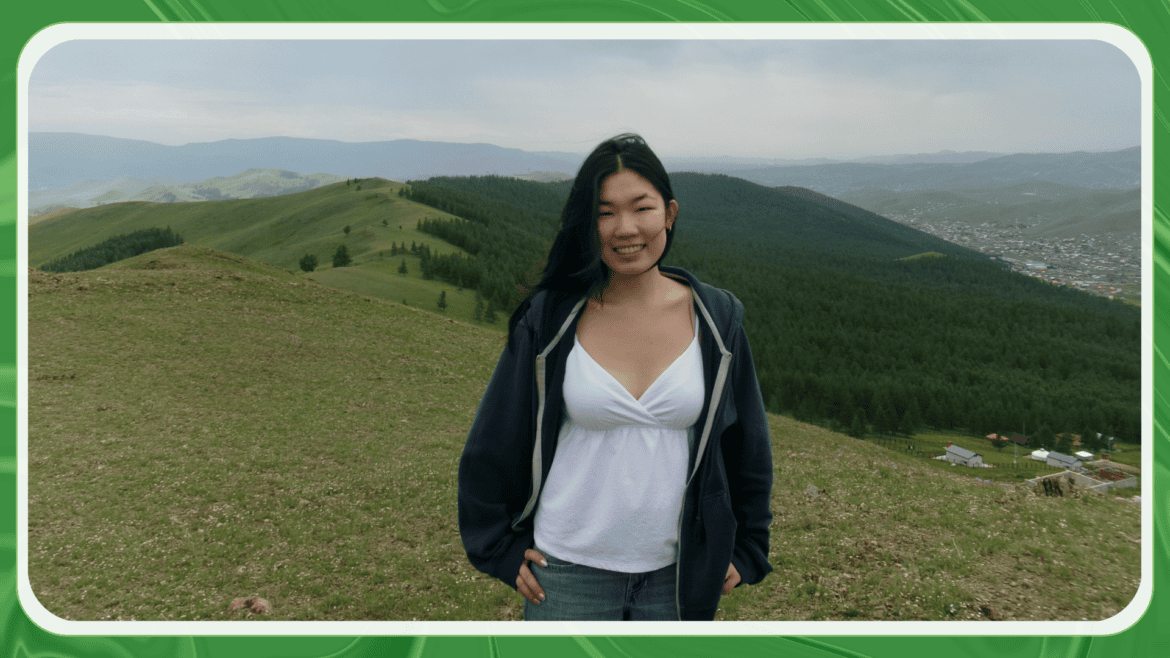
Sarnai, E28, in Mongolia
Sarnai Bold-Erdine, E28, has spent the summer in Ulaanbaatar, Mongolia working with People Centered Conservation (PCC), a nonprofit organization that promotes sustainable natural resource management through community-based conservation. This internship was funded by the Sustainability Exploration Grant, made possible by gifts made to the Office of Sustainability.
Tell us about your time working with People Centered Conservation.
During my time at People Centered Conservation (PCC), I have been working on surveying nomadic women, compiling research, and analyzing data related to conservation and gender equity in Mongolia. One of my main responsibilities has been surveying nomadic women who previously worked with PCC. PCC provided these women with guidance on developing and implementing their own conservation initiatives. My role has been to assess how their experiences and outcomes change after implementing these initiatives, particularly in their ability to take action within their communities and their confidence when communicating with public officials. In addition, I have been compiling research on gender differences in Mongolia’s forest sector. I have collected and reviewed a range of academic and organizational sources and have been analyzing the information to better understand the current state of gender equality in the sector. Overall, my work has given me the opportunity to combine research and data analysis with community-based conservation, while also helping me better understand the social factors that influence environmental initiatives.
What’s something you’ve learned that surprised you?
Something that surprised me during my internship was how PCC approaches sustainability. Before my internship, I understood that sustainability could have socioeconomic benefits, but it was different actually to see that approach in practice. When I thought about sustainability before, I primarily thought about engineering solutions, such as wind turbines, solar panels, and other technologies. Through my work at PCC, I realized that educating people about sustainability and giving them the knowledge and skills to take action can be just as important, if not more important. When people are empowered to make changes within their own communities, they can create a direct and lasting impact. This experience has broadened my understanding of what sustainability means and made me realize that effective environmental solutions are not always technological. Sometimes, empowering people and communities can be one of the most important parts of creating sustainable change.
Are there any lessons you’re hoping to bring back to Tufts?
One of the main lessons I hope to bring back to Tufts is the importance of giving people the tools and resources to take action themselves. At PCC, a lot of the work over the past few years has focused on teaching community members how to plan conservation initiatives, create budgets, and turn their ideas into action. PCC also worked directly with communities to identify the issues people themselves wanted to address and then discussed ways they could tackle them. Ultimately, the goal was to empower the community to take ownership of the solutions. I think this framework could be really valuable on a college campus as well. Providing people with the knowledge and resources to take action can create more lasting change because the community itself becomes capable of continuing the work in the long term, rather than relying on an outside organization.
Another lesson I hope to bring back is the importance of incorporating people’s feedback when developing solutions. This is especially relevant to engineering. Even if you create a technically effective solution, it may not be successful if it doesn’t address what people actually need or if they don’t want to use it. By talking to the people who will be affected by a solution and understanding their needs from the beginning, we can design solutions that are more useful, sustainable, and likely to have a lasting impact.
What would you say to someone curious about getting involved with sustainability?
I would say that getting involved with sustainability is really rewarding, and that even if what you are doing feels small in the grand scheme of things, it is still important to take action. Small actions can add up and create a much larger impact when more people participate. I also think it is important to understand that the social side of sustainability is just as important as the technological side. Before my internship, I often thought about sustainability in terms of technologies like renewable energy, but my experience at PCC showed me how important it is for people and communities to also be involved and empowered to take action. You don’t have to start with something huge. Even simple actions, such as teaching people about properly separating waste or educating younger generations about sustainability, can make a difference. I would encourage people to start wherever they can, because meaningful change often begins with small actions.
Learn more about the Tufts Sustainability Exploration Grant, or make a gift to help fund the next recipient.